Thoughts on IEEE BioCAS Conference 2025 (Abu Dhabi)
 16 Oct 2025
2. My Presentation
3. Feelings
4. Day 1 Summary
5. Day 2 Summary
6. 2025 BioCAS Grand Challenge on Neural Decoding
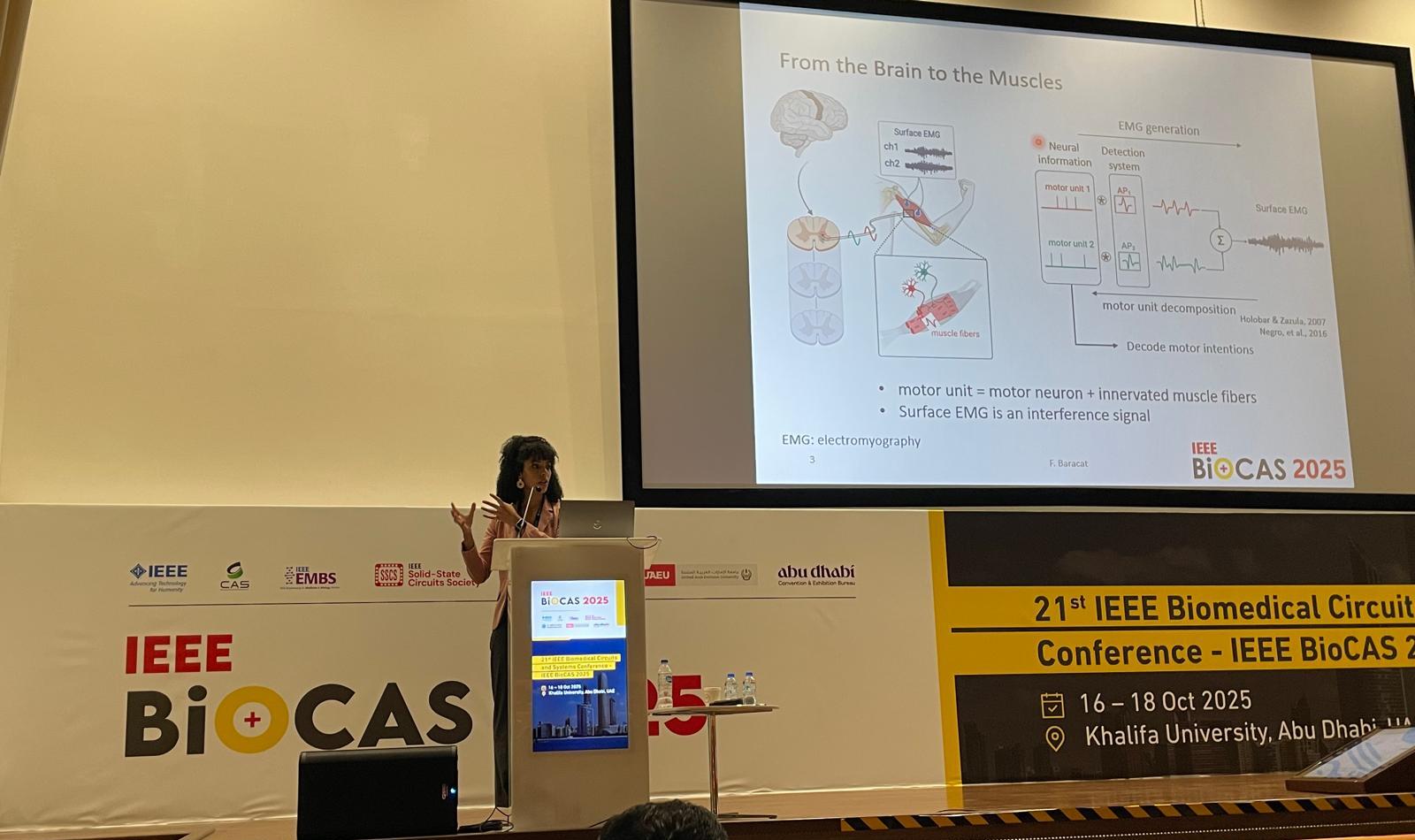
This was the first time attending IEEE BioCAS. It took place in Abu Dhabi (very beautiful city btw) from 16 October 2025 - 18 October 2025. My paper titled Finger Force Decoding from Motor Units Activity on Neuromorphic Hardware got accepted as an oral presentation.
I’ll start this blog with a bit of a rant and some summary thoughts before mentioning a few of the talks I attended.
A Brief Rant
I went there expecting many talks to be heavily focused on circuits, deep dives into ADC details and low-level analog front-end designs for biomedical applications—which, to be honest, I wasn’t particularly looking forward to that part :).
To my surprise, it had a really nice mixture of circuits and biomedical applications. I genuinely enjoyed interacting with other students working on tangent applications: from seizure detection, detecting speech disorders, neural recordings to vagus nerve stimulations for movement restoration to ingestible electronics (think tiny pills equipped with sensors that can continuously monitor the health of internal organs). That last topic was surprising to me in a good way. It was the first time I’d heard of such applications, and I found myself thinking about the packaging, powering, and lifetime of these devices—how long can they actually stay in the body before being expelled? Prof. Rabia Yazicigil talked about this during the WiCAS (Women in CAS) event on the first day, and later, an entire lecture session was dedicated to it.
Interlude: it became even clearer to me how application-driven I am—and not just any applications, but specifically biomedical ones. I love the sense of impact, the human-in-the-loop experiments, and the engineering side that goes into designing these systems.
I was equally surprised to see many research groups working with spiking neural networks (SNNs) from very different standpoints. Some were even combining SNNs with LLMs—the first keynote called them “neuromorphic LLMs”. Others were working on SNN accelerators and related hardware. It seems like SNNs are still a hot topic, that wave is still on-going :) : people want to use them, but often don’t know how, why, or even when they shouldn’t :). There’s a strong influence from the deep learning community, with SNNs being benchmarked on static datasets (sometimes) that lack any temporal information and reporting every possible metric: power, FLOPs, latency, you name it. Well, to be fair, I am not against that either, basically the motivation behind it is just quite different from how I think about and use SNNs. In my view, there are basically two camps here. One camp takes the event-driven and sparse nature of spikes and combines it with traditional ML/DL tools for computation, mainly to reduce power consumption. The outcome is more lightweight deep models that can run efficiently on edge devices. These systems aren’t necessarily fully event-based—they can be mixed or multiplexed with other DL models. The other camp builds on the spatio-temporal nature of SNNs and tries to design hardware that works with computational primitives similar to those in the brain. In this case, we don’t usually combine SNNs with traditional DL models; instead, we explore SNNs on their own—playing with topologies, borrowing computational tricks from the brain, even experimenting with noise as a computational feature.
This second direction feels closer to the original neuromorphic spirit—and it opens up, in my opinion, new possibilities for building end-to-end event-driven systems that are low-power, low-latency, and accurate for selected (this is a key-term here) on-edge applications. Still, I met a few PhD students who seemed to share the same feeling. One of them was working with winner-take-all networks and designing an event-based readout using analog silicon neurons similar to the ones in our chips. At some point over dinner, the conversation opened up on the different types of “neuromophic” and I may or may not have ended up distributing Giacomo’s latest paper to few people :)
My Presentation
I received quite a bit of nice and positive feedback about my presentation on the last day. Comments like “It was quite refreshing”, “I really liked how you designed the slides” or more exagerating “It was the best presentation in the conference so far” are always good to hear.
There weren’t many people in the audience, to be honest—probably because everyone was tired by then, and the schedule had run a bit late. Even so, one of the keynote speaker (he worked with mixed analog neuromorphic hardware) seemed genuinely interested in the topic, and we had a chat afterward about the direct applications of estimating finger forces. I also got some thoughtful questions from the audience (e.g. how do you scale ICA (for motor unit decomposition) for dynamic contractions), which is always a good sign that at least a few people managed to stay awake :).
Feelings
Every time I mention that I’m from the Institute of Neuroinformatics (INI) in Zurich, it’s always something like, “Wow, that’s quite a place!” Or when I mention Giacomo and Elisa, professors smile and say things like, “Giacomo is a great guy—his students always end up in amazing places.”
I felt genuinely grateful and blessed to have the chance to do my PhD at INI. Moments like these remind me how special the environment is and how much it has shaped my journey (and my personality for sure) so far.
On a related (but slightly tangent) note, I was completely caught off guard when someone came up to me and said, “I know your work.” In my head, I was like, Did he just confuse me with someone else? Because honestly, I’ve always assumed my papers are read only by my supervisors and ….occasionaly my brothers (mainly because I make them :)).
The whole time, I was trying to figure out if he’d made a mistake—until he mentioned Elisa and our recent work on heterogeneous population encoding. Phew, that was truly me, LOL :D. We ended up chatting a bit about future directions, and he said he liked the idea and was exploring similar concepts. It was yet another moment of quiet pride—mixed, of course, with my usual dose of modesty and imposter syndrom (because I can’t control it) :D
Day 1 Summary
Keynote 1 Low-power Neuromorphic LLM Accelerators (Prof Hoi-Jun Yoo, KAIST)
- The speaker originally worked on wearable and health care, body-area network then switched to AI accelerators
- Motivation: The exploding LLM sizes –> power consumption also increases (eg. LLama 2 requries 800 W)
- data center power consumption is predicted to increase to be more than a whole city’s
- There is also the problem of location of these data centers which are sitting near urban areas
- Chat GPT announced that there will construct 2 Gwatt data center by end of this year and this is just one company –> not sustainable at all
- How to stop this trend?
- NVIDIA is investing in reducing this trend, they increased performance of their chip from 19TFLOPS to 20000TFLOPs with 350x energy reduction
- The energy efficeincy of the GPU is increasing but also the number of the GPUs are increasing so they aren’t really keeping up with the trend
- At the same time there are smaller versions of the models (for reeasoning for instance) which consume less power but still this isn’t enough to stop the trend.
- Solution:
- Move from the data centers to the edge, which also increases the data privacy
- On ede device, the data is processed where the data is generated –> latency is quite low and we won’t pay money to OpenAI anymore :D
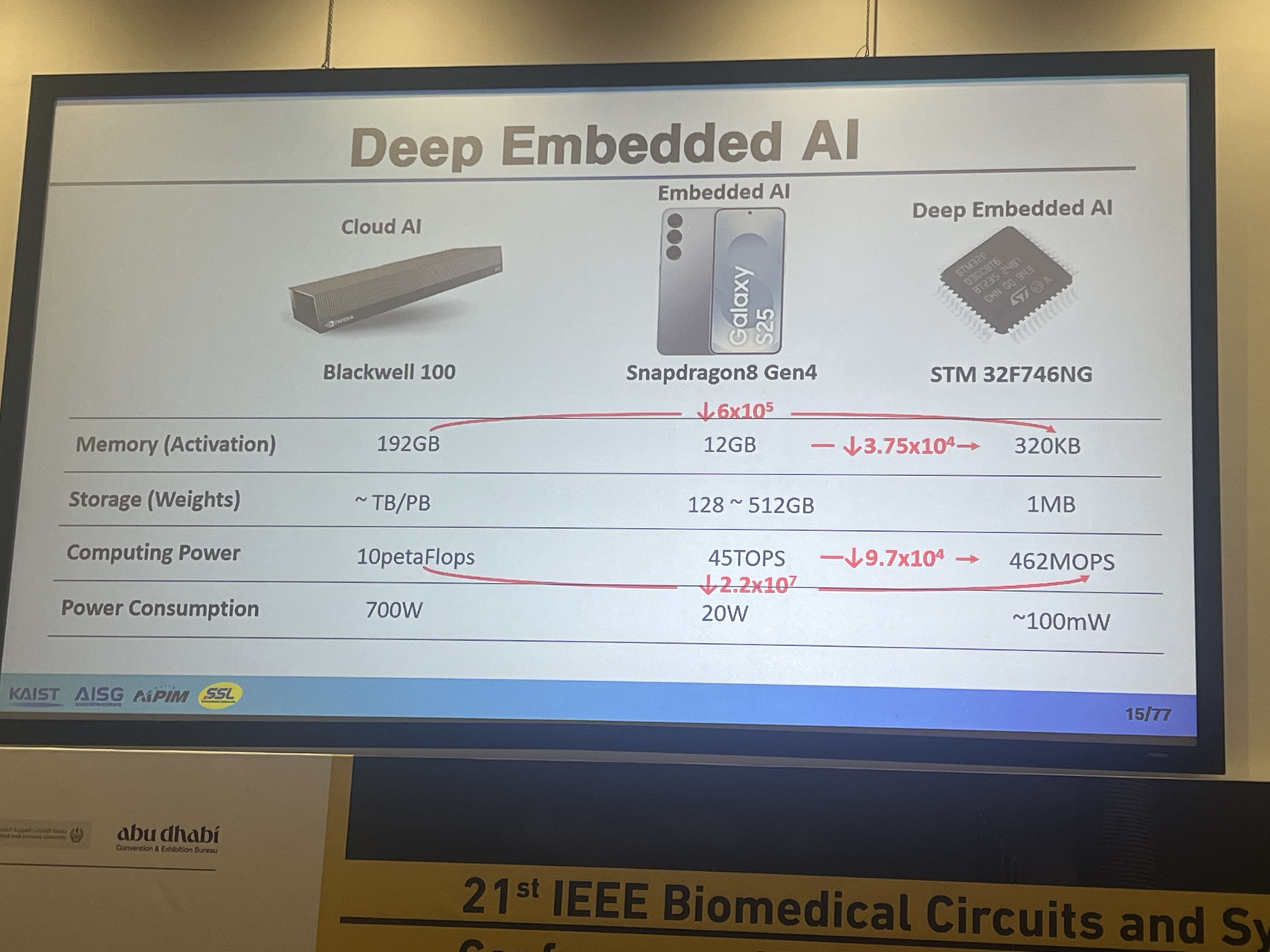
- There are many AI models but only limited models can run on device (on edge)
- Applications of edge LLMs are many: industrial (robotics, autonomous vehicles,…), IoT (smart home, healthcare,…), personal-use (mobile agent, language understanding)
- For the edge devices there is quite a gap between the memory and computing power these devices (and their counterpart running on cloud) to be able to deliver the applications we are hoping for.
- So how can we do better? by taking inspiration from the brain
- The brain is event-driven
- CNN are frame-driven and consume a lot of energy
- SNN on the other hand use event-driven operation: high-sparsity is the essence to the low-power consumption
- Biological neural model are event-driven and information is encoded in spike train
- The gap is that the DL is very accurate and powerful, but how about SNNs:
- Is SNN as accurate?
- Is it scalable enough for LLM?
- How about its future?
- How to train them?
- The solution according to him is through ANN-to-SNN conversion. It is “the way to go” (I fully disagree here).
- Complementary DNN is about adapting the strong pints of CNN and SNN. (See this paper)
- CNN to SNN conversion: main problem is the nonlinear RELU
- He is claiming that SNN has two errors: quantization error and a saturation/clipping error, no matter how large than the threshold the input is, it still gives one single spike.
- He benchmarked on static images CIFAR 10, Image net
- C-Transformer
- I lost it from here onwards :D
- It was about conversion and workload sharing. I beleive the work is properly describe in the paper.
The third tutorial did not take place.
Tutorial 4 (Prof. Andrea De Marcellis): Optical Biotelemetry Systems: Basics, Advances, and Challenges for Biomedical Implants Session
- For implantable systems, we must have: high data rate, high efficiency, small area, small error
- While wired solution can be used for wearable, they aren’t feasible for implantables. One of the most used approach is wireless data communication. Alternatively radiofrequency (RF approach) can be used but this requries antennas. However, antennas consume a lot of area, and have poor electromagnetic compatibility and signal integrity. A good alternative is using light to transmit data (optical wireless communications link)
- For optical wirelesss data communication, we need:
- an emitter or a transmitter. Since we require a very high bandwidth, typically use a large bandwidth laser (VCSEL).
- laser is operated only in a very short time period to reduce power consumption
- signal modulation/ data coding techniques using sub nanosecond laser pulses
- full integration and farbication in standard CMOS in reduced silicon areas
- The main limitation of this approach is the optical misalignent between the transmitter and the receiver and the laser integration in standard CMOS technologies
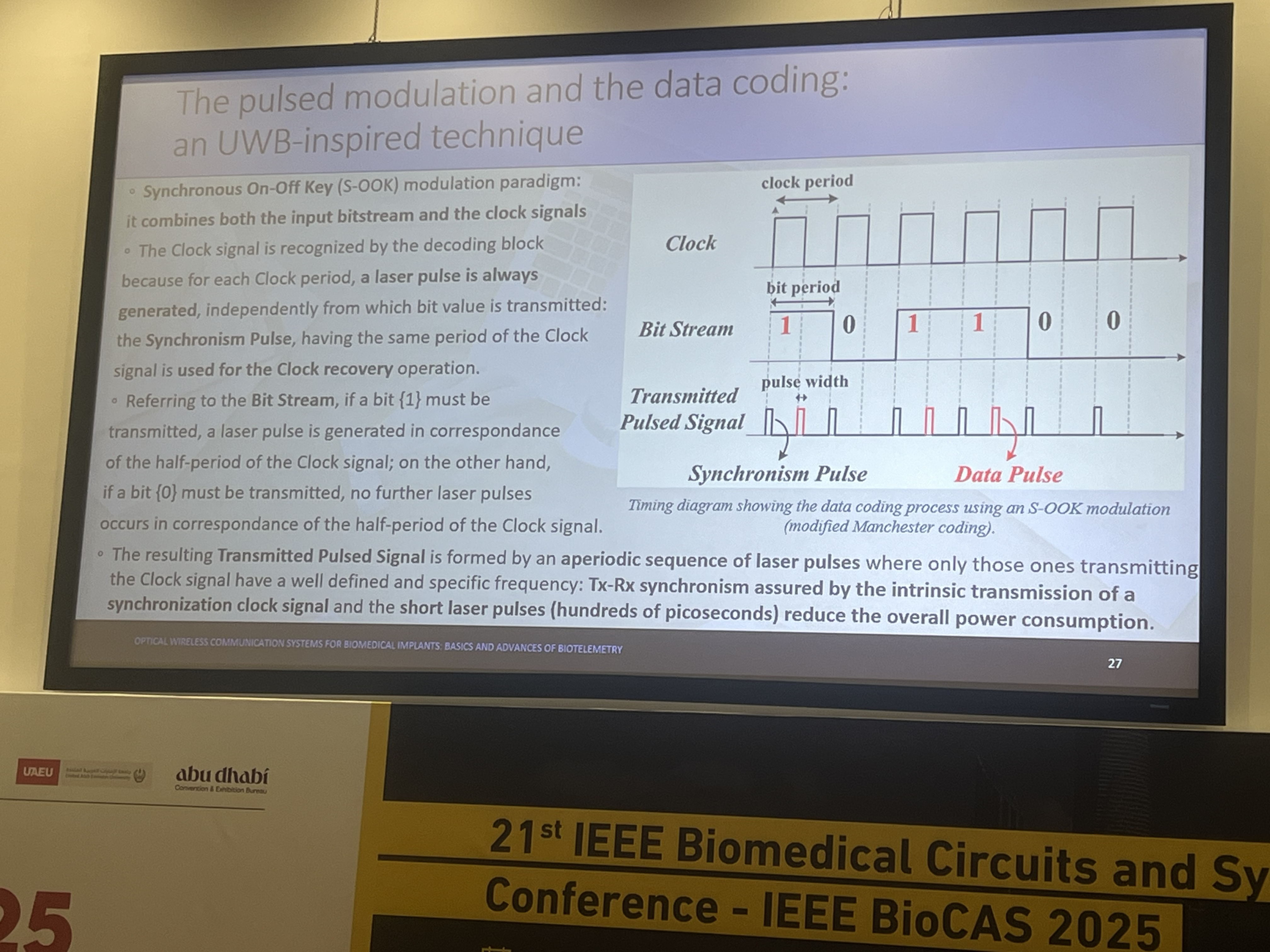
- Regarding the misalignment, using an ultra wideband-inspired (UWB) technique can ensure synchronization between transmitter and receiver with the synchronous on-off key (S-OOK) modulation paradigm: which combines the input bitstream and the clock signal. The general idea is that the clock signal is transmitted at a periodic rate interleaved with the input stream. From the receiver side, only the well-defined and regular pulses define the clock and all-other laser pulses define the data. In general the laser pulses are short enough (100s picoseconds) to reduce the overall power consumption.
Day 2 Summary
Lecture Sesion 1: AI for healthcare
AS-ASR: A Lightweight Framework for Aphasia-Specific Automatic Speech Recognition
- ASR is the process of converting spoken language into text.
- There are two possible pipelines:
- Bottom-up with traditional ASR components: feature extractor (e.g MFCC), acoustic model (HMM), pronounciation lexicon + language model (e.g. n-grams), decoder. The challenge of this approach is the handcrafting of features and expert knowledge + less robust in noisy environment
- End-to-End with deep learning (e.g. Connectionist Temporal Classification, attention-based encoder-decoder, transformer-based models such as Whisper). The benefits: simplified pipeline and better performance in multi-lingual settings.
- This work contribution is on Aphasic (aphasia is a speech disorder) speech recognition with Whisper model.
SpikeVox: Towards Energy-Efficient Speech Therapy Framework with Spike-Driven Generative Language Models
- The aim is to address speech disorder problems –> there is a need for speech theraby solution for assessing, detection, categorize speech disorder and provide feedback for treatments
- Neuromorphic computing can provide energy savings in this regard: eg. spike-driven LLMs (SLMs)
- In this work, they implemented SpikeVox (in Pytorch), with an estimated 5x energy savings over non-spiking model.
Low Complexity Optimization of MLP Framework for Real-Time EEG Seizure Monitoring
- The current research gap is that:
- Existing EEG-based seizure detection models are computationally intensive.
- To have high accuracy, we need full EEG signals and complex features
- Most approaches are not suitable for deployment on the edge –> there is a need for lightweight solutions
- What they propose is a lightweight multi-layer perceptron (5 FC layers) for real-time seizure prediction with ~48.6k parameters
Toward Prediction-Driven Time-Adaptive Seizure Management Using a WC-NMM Network
- An opitmal neuro-stimulation solution for epilepsy treatment requires an automatic calibration of stimulation parameters (e.g magnitude, frequencym duty cycle) per subject across time (i.e adapting over patients and time). This would mean a closed-loop operation between the recording module –> event detection –> activating the stimulator. The stimulator controller should be adapting/ changing with the recording.
- Then the question become, how to speed up the developement of these adaptive controllers when we don’t have a lot of data from patients. One step forward is to develop a digital twin first which can:
- reflect treal brain dynamics (i.e generate iEEG-like signals and simulate seizure dynamics)
- model network behavior in recoridng and simulation
- provide parameteric-specific simulation responses
- be patient-specific
- They developed the digital twin with a WC-NMM network (Wilson-Cowan Neural Mass Model) (a simplified model that describes the large-scale interactions in the brain with EI populations). They looked into the connectome of a part of the cortex (which basically creates a mesh of nodes). Now each node is an EI network on its own. To simualte an iEEG, they assume the electrodes are placed over that part of the cortex (which is modelled by nodes) and compute the contributions of all underlying nodes given their distance to the recording side. What they extract is the post-synaptic potentials (if I am not mistaken). They show that the resulting iEEG activity (in simulation) matches the characteristics of real iEEG data.
2025 BioCAS Grand Challenge on Neural Decoding
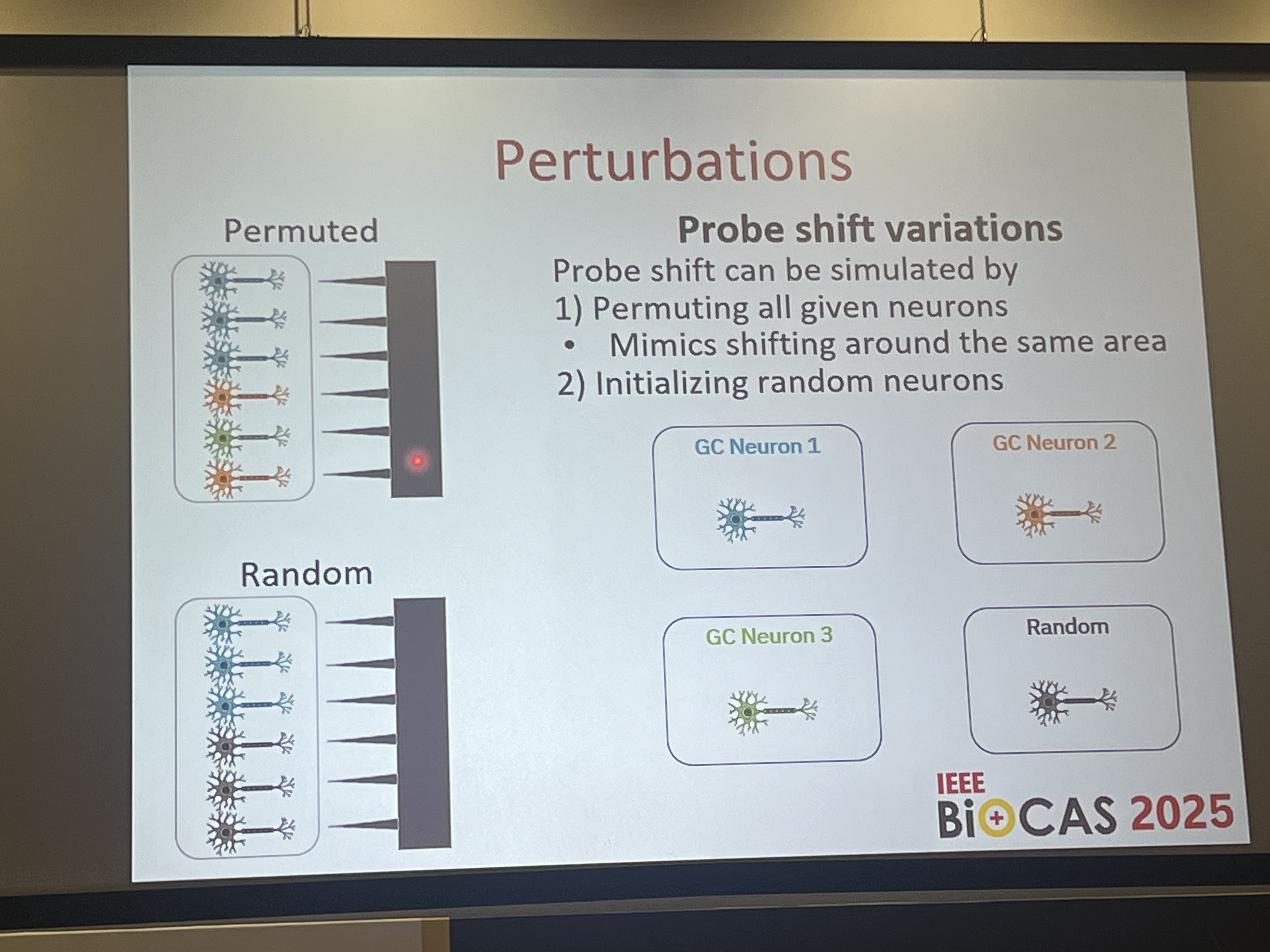
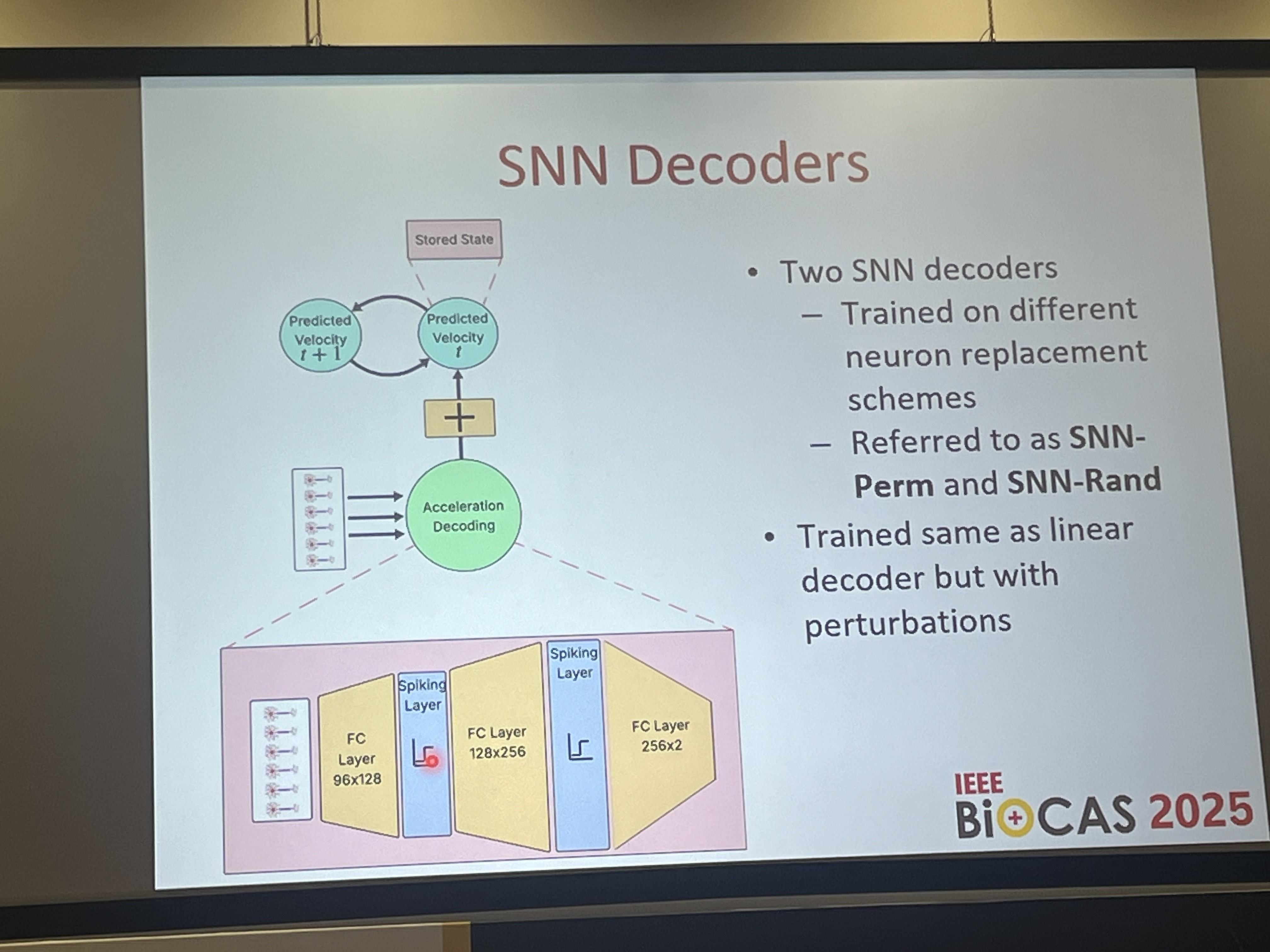
- This year grand challenge on continuous motor decoding from neural data in a closed-loop tasks. The input are neural data form micro-electrode array implanted in the motor cortex, the decoder is supposed to preduct 2d cursor velocities (x and y). A brain model caled Online Prosthesis Simulator (OPS) updates the brain model to give the next neural data point based on the decoder output. There are two main tasks: the first entails desining a decoder that can continuously estimate the accelerations in closed-loop. The second task was the same as before but with added perturbations on the neural recording side, simulating electrode shift.
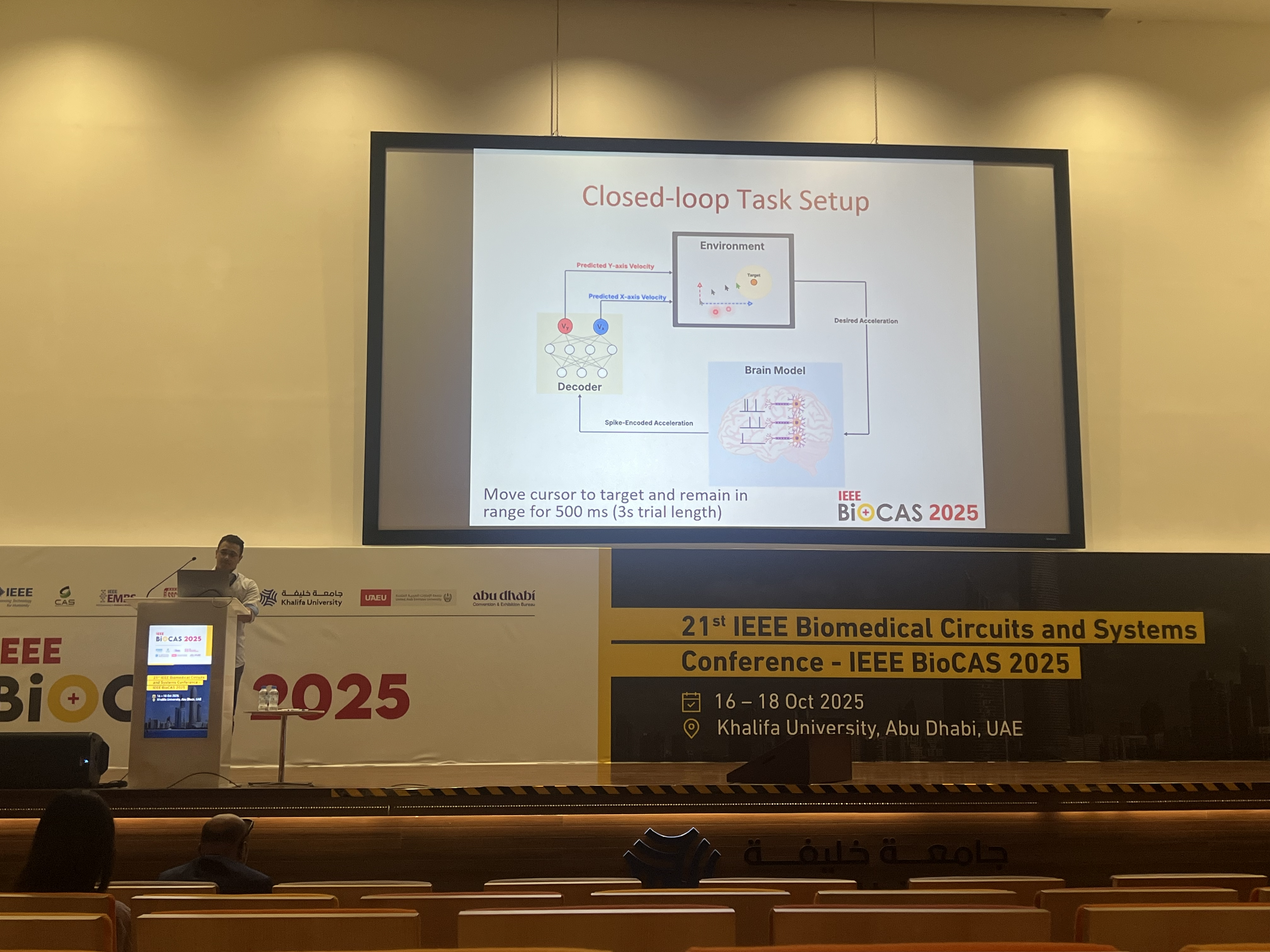
- The winning solution was actually quite simple.
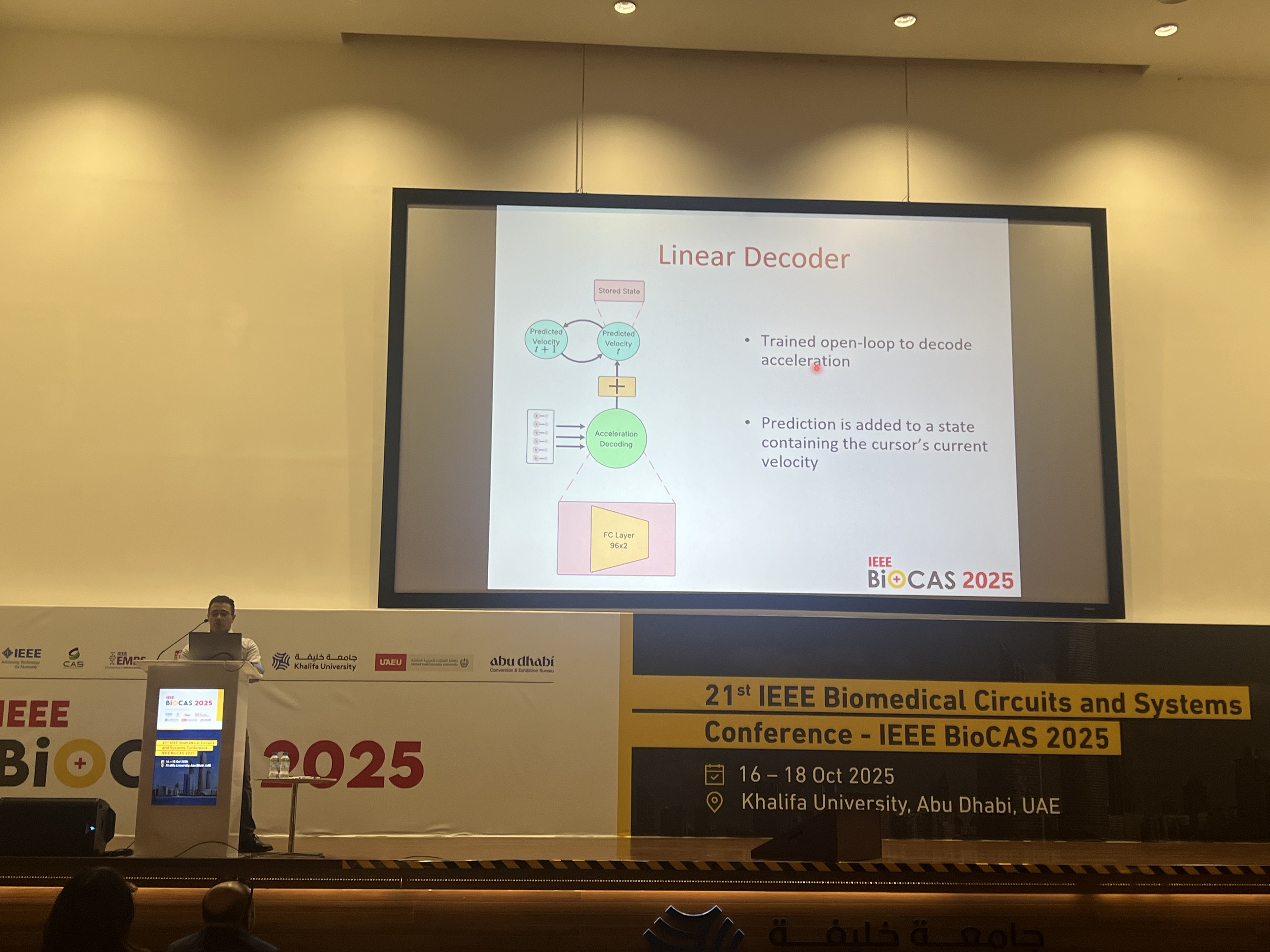
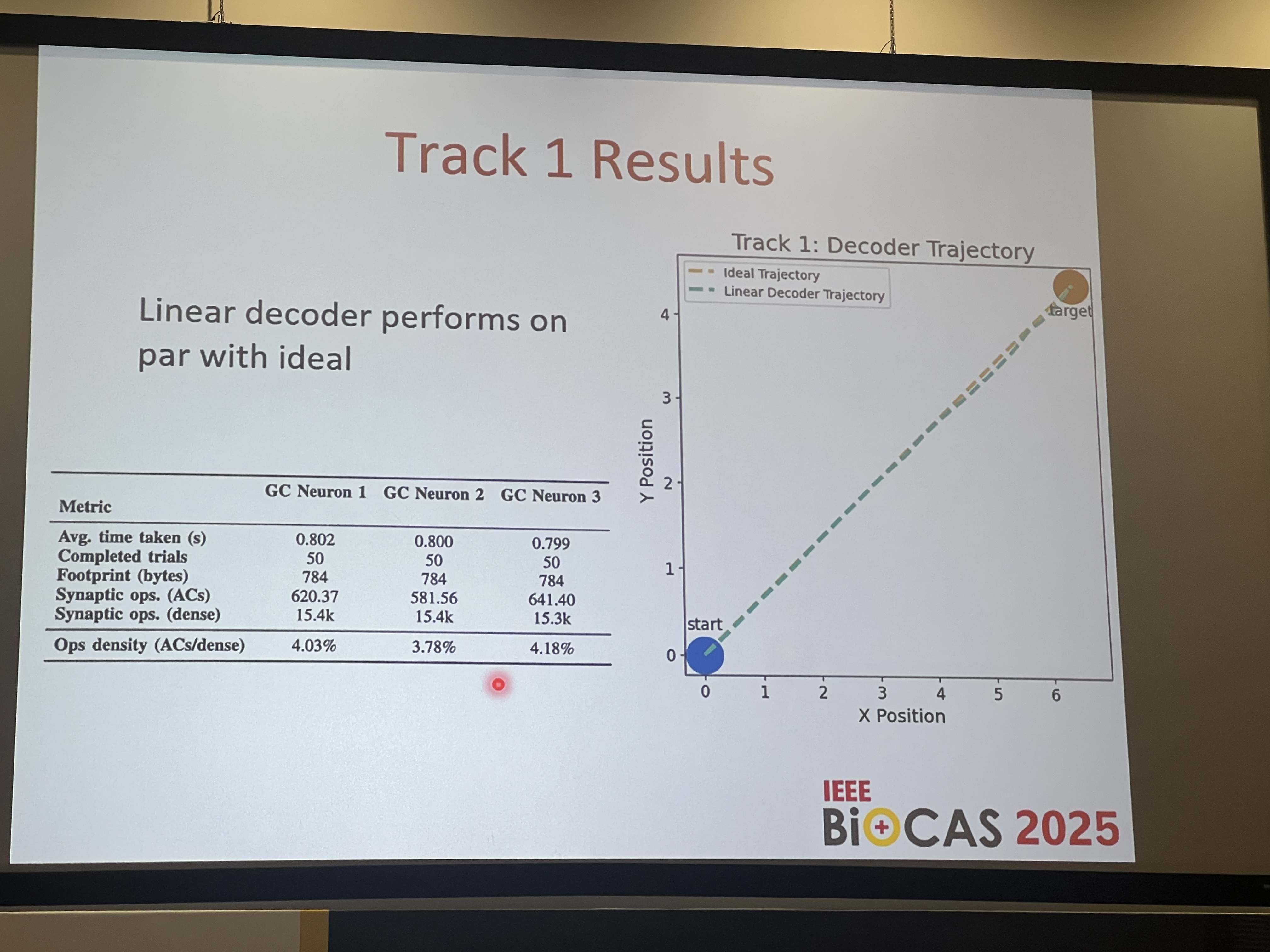
- For the first task (without perturbation), it was a linear decoder trained on an open-loop to predict accelerations from input data with a single fully-connected layer. But they stored the network output (velocities) and kept updating them at each time step.
- For the perturbation task: they trained a slightly bigger SNN network with simulated perturbations