Things I Wish I Did Differently in the PhD
 02 Sep 2026
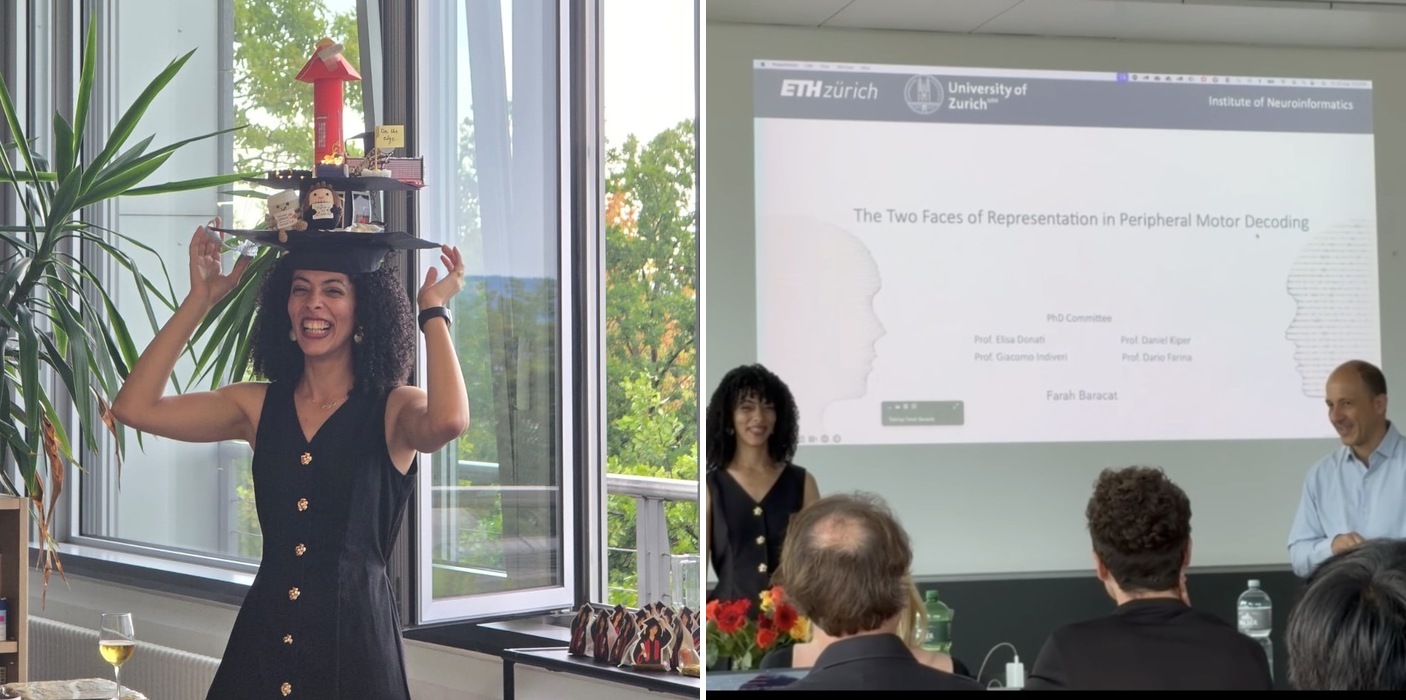
I defended my PhD on some Friday (28th August, to be exact :D), and I’m definitely still processing and letting it sink in.
Not to sound dramatic or anything, but last year, around the same time, the thought of defending used to give me nausea. I felt not ready, like I hadn’t done enough, didn’t know enough… simply wasn’t good enough.
Then slowly, you go with the flow, step by step, and here I am.
Do I feel good enough now? Did this day magically erase my imposter syndrome?
Definitely NOT :D
But for me, it serves as yet another data point. A reminder that I can do whatever I set my mind to. I think confidence is slowly built through how you show up for yourself. Whatever I promise myself, I fully commit to, and this degree is another proof of that. A bit of a tough one, though.
I still don’t feel that I’ve made some huge breakthrough, or that the world has suddenly become a better place for someone else because of my research. Very far from it.
But this journey shaped me much more than I could have imagined. It shaped my self-perception, my understanding of how to deal with self-doubt, how to approach the discomfort of not knowing, and how to navigate a field that is constantly changing.
And the more time passed, the more I found myself thinking: I wish I could go back and redo my PhD with the current version of me. It would have been very different. And I think that, in itself, is a very strong outcome.
The fact that I would approach the same PhD so differently now is probably one of the clearest proofs of how much the process changed me.
I strongly believe that a PhD is not just about the science. It is about the researcher as well. And some of the most important metrics are simply not tangible. For a long time, this was a big problem of mine. I considered papers the main artifact. No papers, no PhD. No papers, not a good researcher. But papers are not the only currency, and they are definitely not the full measure of a researcher. You can publish without having learned that much simply by recycling ideas or techniques, making tiny increments. And you can grow immensely as a researcher in ways that never make it onto a publication list.
It took me a long time to understand that some of the most important outcomes of a PhD are much harder to quantify.
So, if I were to hit restart (truth is I would NEVER want to hit that button; one time is enough :D) these are the things I would do differently.
1. I would choose a problem, not a sequence of projects
Early in my PhD, I thought much more in terms of projects and papers than in terms of problems. There were moments when I started small ideas simply because they seemed cool and doable. Other times, I wanted to submit to a particular conference, so I worked on something that could realistically make it there.
There is nothing fundamentally wrong with that. Small projects can give you quick feedback, expose you to new ideas, and give you the satisfaction of actually finishing something.
The problem is when your entire PhD becomes a collection of these projects.
Looking back, I would spend much more time asking myself: What is the problem I actually want to understand?
Not: What can I publish next?
Not: What technique can I apply here?
But: What is the problem that is important enough and interesting enough for me to keep coming back to?
Of course, I wouldn’t have known the solutions in advance. That is the whole point of research. The methods, techniques, and even the precise questions evolve with time and experience. But having a problem as an anchor would have changed how I chose projects.
Instead of asking whether an idea could become a paper, I would also ask whether working on it would move me deeper into a territory I actually wanted to understand.
In retrospect, I can connect my projects into a narrative, and I did exactly that for my thesis :D. But I would have preferred for some of those connections to exist a priori, rather than discovering them retrospectively.
Fast projects give you turnover. They can give you publications. But constantly jumping between small problems can also prevent ideas from simmering in your mind long enough for you to develop real depth.
I would play the long game much earlier.
2. I would spend more time developing an opinion about my field
One thing I value much more now is not simply knowing a topic, but having an opinion about it.
What problems actually matter?
Which approaches are promising?
Which ones are being overused?
What assumptions does everyone seem to accept?
What is missing?
Where could this field go next?
I don’t think you develop that perspective by simply doing more experiments. You develop it by reading a lot and, more importantly, by learning to read critically:
What did the authors actually contribute?
What did they miss?
What is good about the paper?
What is weak?
Where does this work sit relative to everything else?
Can I summarize its contribution in one sentence?
Over time, those questions build something bigger than knowledge. They build taste. And eventually, hopefully, they help you develop your own intellectual territory: an area where people begin to associate you with a particular problem, combination of ideas, or way of thinking.
I wish I had consciously optimized for that earlier.
3. I would treat reading and thinking as work
I personally struggled a lot with the balance between consuming and producing. For most of my PhD, producing felt like work.
Coding was work. Running experiments was work. Writing a paper was work. Reading somehow felt… less like work.
If I spent an afternoon reading papers instead of implementing something, part of me would feel that I hadn’t really produced anything that day.
And because of that mindset, there are topics related to my own work where I know less than I wish I did. Towards the end of my PhD especially, I lost touch with some of the progress in the field because I was drowning in deadlines.
Looking back, I think this was a mistake.
Reading is work. Thinking is work. Spending half a day trying to understand why a paper works is work. Following references until you finally understand where an idea came from is work.
None of these things immediately materialize into an artifact, but they change the quality of the artifacts you eventually produce.
Interestingly, this balance is changing now with coding agents. Implementation can be dramatically faster, and a lot of the coding frustration that used to consume both time and mental sanity can be reduced.
But I think that makes the distinction even more important.
Just because something can be implemented for you doesn’t mean there is no value in implementing it yourself at least once. Sometimes struggling through an implementation is the learning investment.
The goal isn’t to manually do everything. The goal is to know when the struggle is teaching you something.
4. I would be much more willing to be slow at the beginning
Time was probably my biggest imaginary enemy during the PhD.From day one, I somehow felt that I was already running out of it.
I needed results. I needed papers. I needed to publish.
And the funny thing is: much of that pressure existed primarily in my own head.
That feeling affected the problems I chose and, more importantly, how willing I was to invest in learning something difficult.
Sometimes a new direction meant first learning the mathematics behind a technique. Other times it meant establishing a recording setup from scratch, with a significant engineering effort before I could even start answering the scientific question.
And sometimes I would look at that initial investment and think: this will take too long. So I would take the easier problem or the easier solution.
I understand that instinct. Research has deadlines, and at some point things do need to work. But if I were starting again, I would be much more willing to be slow at the beginning.
I would ask a different question. Instead of: How quickly can this become a result? I would ask: What will I know how to do after this that I don’t know how to do today? Because the math you spend two weeks learning, the experimental setup you struggle to build, or the technique that initially makes absolutely no sense might not produce the fastest paper. But it might permanently expand the kinds of problems you are capable of solving. And that compounds.
5. I would learn more through other people
Finally, I would collaborate more and especially outside my immediate bubble. Some of the best collaborations are not simply two people dividing tasks. They are collaborations where the two people bring genuinely complementary ways of thinking or skill sets.
Working closely with another PhD student, especially someone from another lab or even another field, exposes you to much more than their technical knowledge. You see how they approach problems. What they notice that you don’t. What tools they reach for naturally. What assumptions they question. And suddenly your own idea space gets bigger.
Looking back, I think collaborations are one of the most underrated ways of investing in your own learning. Yes, they expand your network. Yes, they can lead to papers. But those are almost secondary.
The real value is that other people expand the set of things you can imagine doing.
So NOPE, finishing the PhD didn’t suddenly make me feel like I know enough. If anything, I am probably more aware now of how much I don’t know, and of how many mistakes I made throughout this journey :D.
Five years ago, I thought the main evidence that I was becoming a researcher would be the things I produced. Now I think part of the evidence is simply that, if I were dropped back at the beginning tomorrow, I would ask different questions, choose problems differently, learn differently, and think differently.
I would do the PhD differently because I am not the same researcher who started it. And this is the true value!